Fitting a composed distribution
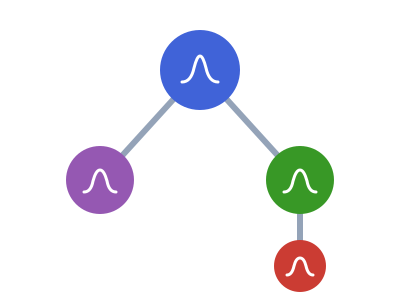
A composed tree carries its own estimation boundary. The uncertain leaves mark which parameters are free, and everything else is held fixed. A bare tree with no uncertain leaves estimates nothing, so fitting always starts by saying what is uncertain.
This page shows the three ways to fit a tree, all built on one PPL-neutral log-density.
The log-density
as_logdensity packages a tree and its data into a log-density over just the estimated parameters. The estimated parameters are the uncertain rows of params_table, in that order, and flat_dimension counts them.
using ComposedDistributions, Distributions

tree = compose((
    onset_admit = uncertain(Gamma(2.0, 1.0); shape = LogNormal(log(2.0), 0.2)),
    admit_death = LogNormal(0.5, 0.4)))
data = [[0.5, 2.0], [1.0, 3.0], [0.8, 2.5]]

prob = ComposedDistributions.as_logdensity(tree, data)
ComposedDistributions.flat_dimension(tree)1The one free parameter here is onset_admit's shape. logdensity scores a flat parameter vector, adding the priors' log-density to the data likelihood of the tree rebuilt at those values.
ComposedDistributions.logdensity(prob, [2.0])-7.712871135007962Promote a fixed tree to estimate its free parameters with default priors through uncertain(tree) (equivalently update(tree, param_priors(tree)), the mechanism it is built on).
Sampling without Turing
DistributionsInference.jl builds a LogDensityProblems-conformant problem for any composed tree, generically, over this same PPL-neutral core (via its fit-protocol extension, parameter_rows/reconstruct) — no weakdep extension in this package (#220). A gradient comes from wrapping it with LogDensityProblemsAD and a backend the codec differentiates under (ForwardDiff, ReverseDiff or Mooncake).
using DistributionsInference, LogDensityProblems, LogDensityProblemsAD, ForwardDiff, AdvancedHMC

prob = DistributionsInference.as_logdensity(tree, data)
LogDensityProblems.dimension(prob)              # 1
grad = ADgradient(:ForwardDiff, prob)
# hand `grad` to AdvancedHMC / DynamicHMC / Pathfinder
Samplers work on an unconstrained vector, so a positive or simplex parameter needs its transform; DistributionsInference.jl's own Bijectors extension supplies it generically the same way.
Sampling with Turing
DistributionsInference.jl's as_turing wraps the same log-density as a DynamicPPL model, so a tree is sampleable with Turing directly (#233 — this package no longer carries its own as_turing, which collided with this one when both packages were loaded). It is a light layer over the codec, with each estimated parameter a named site drawn from its own prior and the data likelihood added from the tree rebuilt at the draw.
using DistributionsInference, Turing

chain = sample(DistributionsInference.as_turing(tree, data), NUTS(), 1000)
Reading the fit back
Chain readback is DistributionsInference.jl's, not this package's own (#221): DistributionsInference.readback reduces a fitted chain straight to a rebuilt tree, collapsing every uncertain leaf; readback_draws keeps every draw for a posterior summary. Both work generically over the fit-protocol core above, so the same two calls read back a tree fitted through as_logdensity or through as_turing.
using DistributionsInference, FlexiChains

fit = DistributionsInference.readback(tree, chain)      # the fitted tree
event(fit, :onset_admit)                                # a concrete Gamma
draws = DistributionsInference.readback_draws(tree, chain)   # every draw
The tools
| Tool | What it gives | Loaded with |
|---|---|---|
as_logdensity | the PPL-neutral log-density over the estimated parameters | base package |
logdensity / flat_dimension | evaluate the density, count the parameters | base package |
DistributionsInference.as_logdensity | the same core wrapped as a LogDensityProblems problem, generically | DistributionsInference |
DistributionsInference.to_constrained-equivalent transform | the unconstrained transform and its log-Jacobian | DistributionsInference + Bijectors |
DistributionsInference.as_turing | a DynamicPPL model for sample(...) | DistributionsInference + DynamicPPL |
DistributionsInference.readback / readback_draws | read a fitted chain back onto the tree | DistributionsInference + FlexiChains |